
Have you been investing in speech therapy for yourself or a family member and wondering if those expenses could reduce your tax burden? You're not alone. Many families spending thousands on therapeutic services each year ask the same question: can speech therapy be tax deductible? The short answer is yes, but there are specific requirements you'll need to meet.
TL;DR: Speech therapy expenses can qualify as tax-deductible medical expenses if you itemize deductions and your total medical costs exceed 7.5% of your adjusted gross income. You'll need documentation proving medical necessity, and the therapy must treat a diagnosed condition rather than general skill development.
Understanding Medical Expense Deductions for Therapy
The IRS allows you to deduct qualifying medical expenses, including speech therapy, but only under certain conditions. According to IRS guidelines on medical expense deductions, you must itemize your deductions rather than taking the standard deduction. This means your total itemized deductions need to exceed the standard deduction amount to make financial sense.
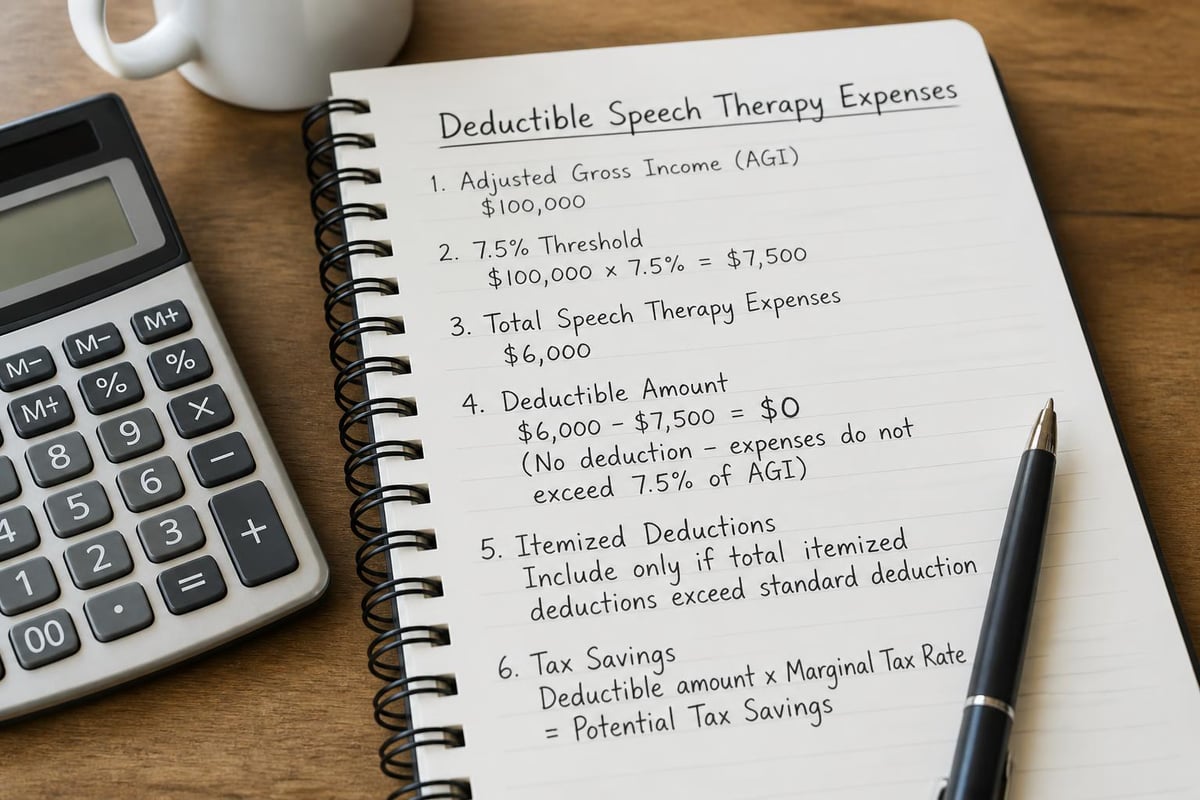
For 2026, the threshold remains at 7.5% of your adjusted gross income (AGI). Here's what that means: if your AGI is $80,000, only medical expenses exceeding $6,000 would be deductible. If you spent $10,000 on speech therapy and other medical costs, you could deduct $4,000.
What Qualifies as Deductible Speech Therapy?
Not all speech therapy automatically qualifies. The IRS requires that therapy address a specific medical condition or diagnosed disability. Speech therapy prescribed by a licensed physician or specialist for conditions like:
- Stroke recovery
- Traumatic brain injury
- Autism spectrum disorder
- Developmental delays
- Neurological conditions affecting speech
- Stuttering or fluency disorders
These therapeutic interventions typically meet the medical necessity requirement. However, speech coaching for public speaking improvement or accent reduction wouldn't qualify since they're considered personal development rather than medical treatment.

Documentation Requirements You'll Need
When claiming can speech therapy be tax deductible expenses, documentation is everything. The IRS may request proof that your therapy was medically necessary, so maintaining thorough records protects you during an audit.
Essential documents to keep:
- Letter of medical necessity from your healthcare provider
- Diagnosis codes (ICD-10) for the condition being treated
- Treatment plan outlining therapy goals and duration
- Itemized receipts showing dates, amounts, and provider information
- Insurance explanation of benefits (EOB) statements
- Mileage logs if traveling to appointments
Your healthcare provider should clearly state why speech therapy is medically necessary for your specific condition. Generic letters won't suffice. The documentation should establish a direct connection between your diagnosis and the prescribed treatment.
Using FSA and HSA Funds for Speech Therapy
Beyond tax deductions, you have additional options for managing speech therapy costs tax-efficiently. Speech therapy qualifies as an FSA-eligible expense when medically necessary, allowing you to use pre-tax dollars for treatment.
| Account Type | Tax Advantage | Annual Limit (2026) | Rollover Rules |
|---|---|---|---|
| FSA | Pre-tax contributions | $3,200 | Limited ($640 max) |
| HSA | Pre-tax + growth | $4,300 individual / $8,550 family | Unlimited |
| Standard Deduction | Post-tax reduction | Based on AGI | N/A |
Health Savings Accounts offer even more flexibility. As explained in resources about HSA eligibility for speech therapy, you can use HSA funds for qualified medical expenses at any time, and unused funds roll over indefinitely.
Calculating Your Potential Tax Savings
Let's walk through a realistic scenario. Suppose you're in the 22% tax bracket with an AGI of $100,000. Your family receives speech therapy through Hansel Union Consulting, PLLC and other medical services throughout 2026:
- Total medical expenses: $15,000 (including speech therapy)
- AGI threshold (7.5%): $7,500
- Deductible amount: $7,500
- Tax savings (22% bracket): $1,650
That's real money back in your pocket. However, remember this only works if you itemize deductions and your total itemized deductions exceed the standard deduction ($29,200 for married filing jointly in 2026).
Combining Multiple Therapeutic Services
Many families receiving speech therapy also benefit from other therapeutic services. At Hansel Union Consulting, PLLC, comprehensive care often includes behavioral, occupational, and physical therapies alongside speech services. The good news? You can combine all qualifying medical expenses when calculating your deduction.
Potentially deductible therapy costs include:
- Speech therapy sessions and evaluations
- Occupational therapy for developmental delays
- Physical therapy for neurological conditions
- Behavioral therapy for autism spectrum disorder
- Psychological counseling when medically necessary
- Transportation costs to and from appointments
According to comprehensive guides on therapy tax deductions, even mileage to appointments qualifies at the standard medical mileage rate (21 cents per mile for 2026).
Common Mistakes to Avoid
When determining can speech therapy be tax deductible for your situation, watch out for these frequent errors that could trigger an audit or disqualification:
Missing the medical necessity documentation. Without a clear diagnosis and treatment plan from a licensed provider, your deduction may be rejected. Keep detailed records from the start.
Claiming ineligible services. Educational tutoring that happens to address speech isn't the same as medical speech therapy. The distinction matters to the IRS.
Forgetting to reduce for insurance reimbursements. You can only deduct out-of-pocket costs. If insurance covered $5,000 of a $10,000 bill, you can only claim the $5,000 you paid.

Insurance Coordination and Out-of-Pocket Maximums
Understanding how insurance interacts with tax deductions helps you plan more effectively. Many families reach their out-of-pocket maximum early in the year when managing ongoing therapeutic needs. Once you've met that threshold, additional covered services don't generate deductible expenses since you're not paying out of pocket.
However, services your insurance doesn't cover, copayments, and amounts applied to your deductible all count toward your medical expense deduction. As noted in resources about FSA and HSA eligibility for speech therapy, coordinating these benefits strategically maximizes your tax advantages.
Planning Ahead for Maximum Tax Benefits
Smart tax planning means thinking beyond April 15th. If you're close to the 7.5% AGI threshold late in the year, consider whether scheduling additional medically necessary treatments before December 31st makes sense. This strategy, called "bunching" medical expenses, can push you over the threshold in high-expense years.
Keep a running total of medical expenses throughout the year. Many families are surprised to discover they've exceeded the threshold when they tally everything in tax season. Regular tracking helps you make informed decisions about timing elective procedures or intensive therapy programs.
Understanding can speech therapy be tax deductible helps families access needed services while managing costs effectively. By maintaining proper documentation, coordinating insurance benefits, and planning strategically, you can maximize available tax advantages for your therapeutic expenses. If you're seeking quality speech therapy and comprehensive therapeutic services for yourself or a loved one with developmental, intellectual, or neurological disabilities, Hansel Union Consulting, PLLC has served families across Hampton Roads and Virginia since 2010 with personalized, compassionate care that supports long-term growth and quality of life.