
When you're working with children who have speech sound disorders, you've probably noticed something interesting. They might handle simple words like "cat" or "dog" just fine, but introduce a word like "elephant" or "banana," and suddenly things get tricky. That's where speech therapy 3 syllable words become absolute game-changers in your treatment approach. These medium-complexity words create the perfect bridge between basic articulation and more advanced speech patterns, giving your young clients the practice they need without overwhelming them.
Why Three-Syllable Words Matter in Speech Development
Three-syllable words occupy this sweet spot in speech therapy that makes them incredibly valuable. They're complex enough to challenge kids but not so intimidating that they shut down before trying.
Think about it. When a child masters two-syllable words, jumping straight to four or five syllables can feel like climbing Mount Everest. But three-syllable words? They're the stepping stones that build confidence and skill simultaneously.

Common Challenges with Multisyllabic Words
Children face specific hurdles when tackling longer words. They might:
- Drop entire syllables (saying "nana" instead of "banana")
- Reverse syllable order ("aminal" instead of "animal")
- Struggle with stress patterns (emphasizing the wrong syllable)
- Lose clarity in unstressed syllables
According to research on multisyllabic word challenges, these difficulties often stem from motor planning issues rather than simple articulation problems. Your job becomes helping children coordinate the complex movements needed for longer utterances.
Essential Categories of Speech Therapy 3 Syllable Words
Let me break down the most useful word categories you'll want in your therapy toolkit. Each serves a different purpose in building speech skills.
Early Practice Words
These are your go-to words when introducing three-syllable patterns:
- Animal names (elephant, butterfly, buffalo)
- Food items (banana, tomato, pineapple)
- Everyday objects (bicycle, computer, umbrella)
- Family terms (grandmother, minister, anyone)
Start here because kids already know these words. They're familiar, which means cognitive load stays low while motor planning load increases.
Target-Specific Practice Words
| Initial Sound | Example Words | Therapy Focus |
|---|---|---|
| /k/ sound | cucumber, kangaroo, calendar | Velar placement |
| /s/ sound | Saturday, Saturday, cinema | Sibilant clarity |
| /r/ sound | raspberry, recorder, restaurant | R-colored vowels |
| /l/ sound | lemonade, library, lobster | Lateral production |
This comprehensive syllable resource offers hundreds more options for targeting specific sounds within three-syllable contexts.
Practical Activities for Three-Syllable Word Practice
You can't just drill words repeatedly and expect engagement. Kids need variety, challenge, and fun woven together.
Syllable Tapping and Clapping
Have your client tap out each syllable while saying the word. This multisensory approach reinforces the rhythm and structure of speech therapy 3 syllable words. You can use:
- Hand claps for each syllable
- Drumsticks on a practice pad
- Jumping or hopping movements
- Colored blocks to represent each syllable
The physical movement connects motor memory with speech production in powerful ways.
Stress Pattern Games
Three-syllable words come in different stress patterns. The most common in English is strong-weak-weak (EL-e-phant), but you'll also find weak-strong-weak (ba-NA-na) and weak-weak-strong (kang-a-ROO).
Create sorting games where children categorize words by stress pattern. This develops their prosodic awareness, which impacts overall intelligibility more than individual sound accuracy sometimes.

Real-World Application Tasks
- Shopping lists: Have kids say three-syllable food items they'd buy
- Story creation: Build narratives using target words
- Describe and guess: One person describes an object using only three-syllable words
- Memory games: Match cards while practicing word production
The multisyllabic words activities guide provides additional structured approaches you can adapt to individual client needs.
Progression Strategies That Actually Work
How do you know when a child's ready to move from two syllables to speech therapy 3 syllable words? Look for these markers.
Readiness Indicators
Your client should demonstrate:
- 80% accuracy on two-syllable words in connected speech
- Ability to maintain voicing throughout longer utterances
- Basic understanding of syllable concepts
- Attention span sufficient for 3-4 repetitions
Don't rush this progression. Building a solid foundation prevents frustration later.
Scaffolding Techniques
| Technique | Description | When to Use |
|---|---|---|
| Syllable segmentation | Practice each syllable separately, then blend | Initial introduction |
| Carrier phrases | Embed target word in simple sentence ("I see a…") | Building fluency |
| Backward chaining | Master final syllable first, add preceding ones | Motor planning difficulties |
| Reduced rate | Slow production with natural pauses | Coordination challenges |
These specialized multisyllabic word tools can supplement your therapy materials with structured progression systems.
Technology and Resource Integration
We're living in 2026, and technology offers incredible support for practicing speech therapy 3 syllable words between sessions.
Apps and Digital Tools
Modern apps like Articulate Multisyllabic provide interactive practice with immediate feedback. Parents can use these at home to reinforce therapy goals without needing clinical expertise.
Video Modeling Resources
Visual learning helps many children. Resources like multisyllabic word practice videos let kids see and hear proper production. They can pause, replay, and practice alongside the model as many times as needed.
For children with apraxia, three-syllable phrase practice videos address the specific motor planning components that make these words challenging.
Home Practice Guidelines for Families
Your therapy sessions are crucial, but real progress happens when practice extends beyond your office. Give families clear, achievable homework.
Daily Practice Structure
Recommend:
- 5-10 minutes of focused practice
- 3-5 target words per session
- Multiple repetitions (aim for 50-100 trials spread throughout the day)
- Natural contexts whenever possible
Make practice feel less like work by embedding it into routines. Say three-syllable words during meal prep, car rides, or bedtime routines.
Tracking Progress
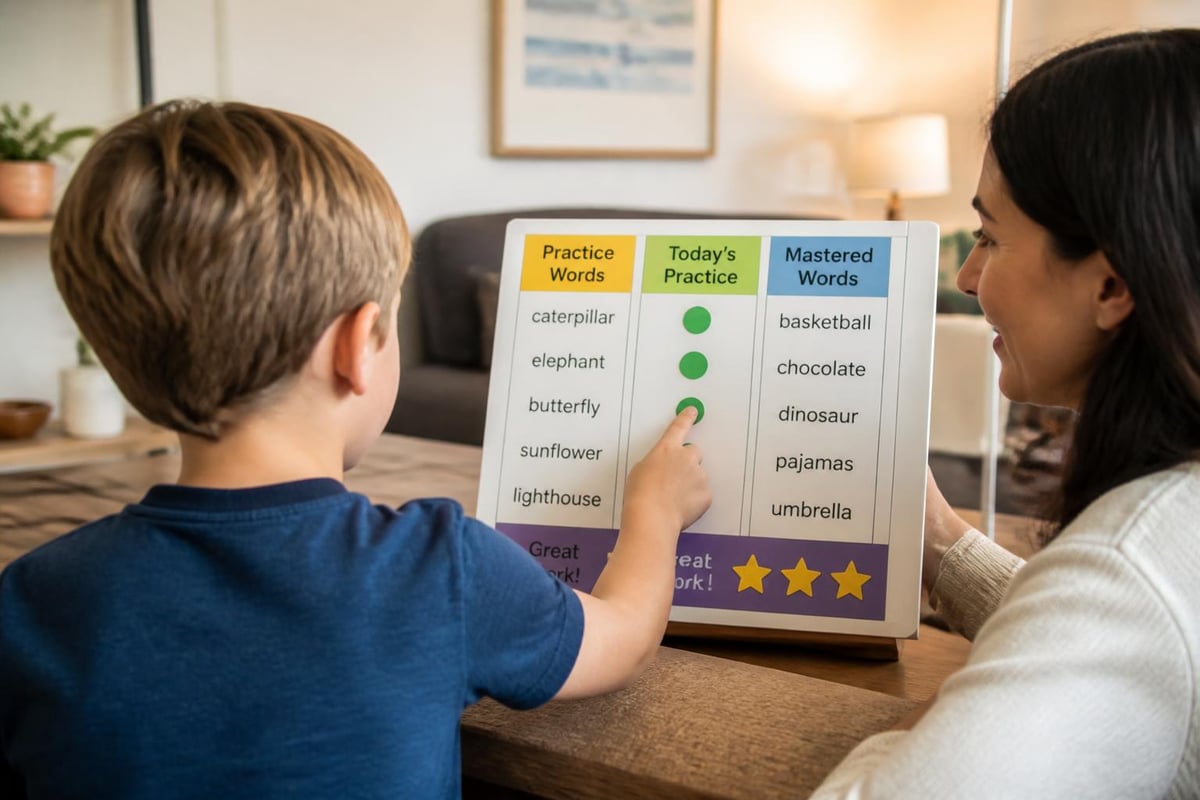
Create simple tracking sheets where parents mark successful productions. This data helps you adjust therapy targets and celebrates small wins that motivate continued effort.
Addressing Individual Differences
Not every child responds to the same approaches with speech therapy 3 syllable words. You need flexibility in your methods.
Some kids thrive on structured drill work. Others need game-based learning to stay engaged. Some require visual supports, while others do better with auditory modeling alone. Your clinical judgment determines which approach fits each unique client.
Watch for signs of frustration. If a child struggles consistently with three-syllable words, you might need to strengthen two-syllable skills first or investigate whether other issues (hearing, language comprehension, attention) are interfering with progress.
Mastering three-syllable words represents a significant milestone in speech development, requiring systematic practice and appropriate scaffolding to achieve success. Whether you're a parent supporting your child's speech journey or a professional seeking evidence-based strategies, working with experienced therapists makes all the difference. Hansel Union Consulting, PLLC has served the Hampton Roads and Virginia communities since 2010, offering comprehensive speech therapy services tailored to each individual's unique needs and helping children reach their full communication potential.